

A successful finish starts with a compatible pad and a planned sequence. The final grit cannot automatically correct scratches left earlier in the process.
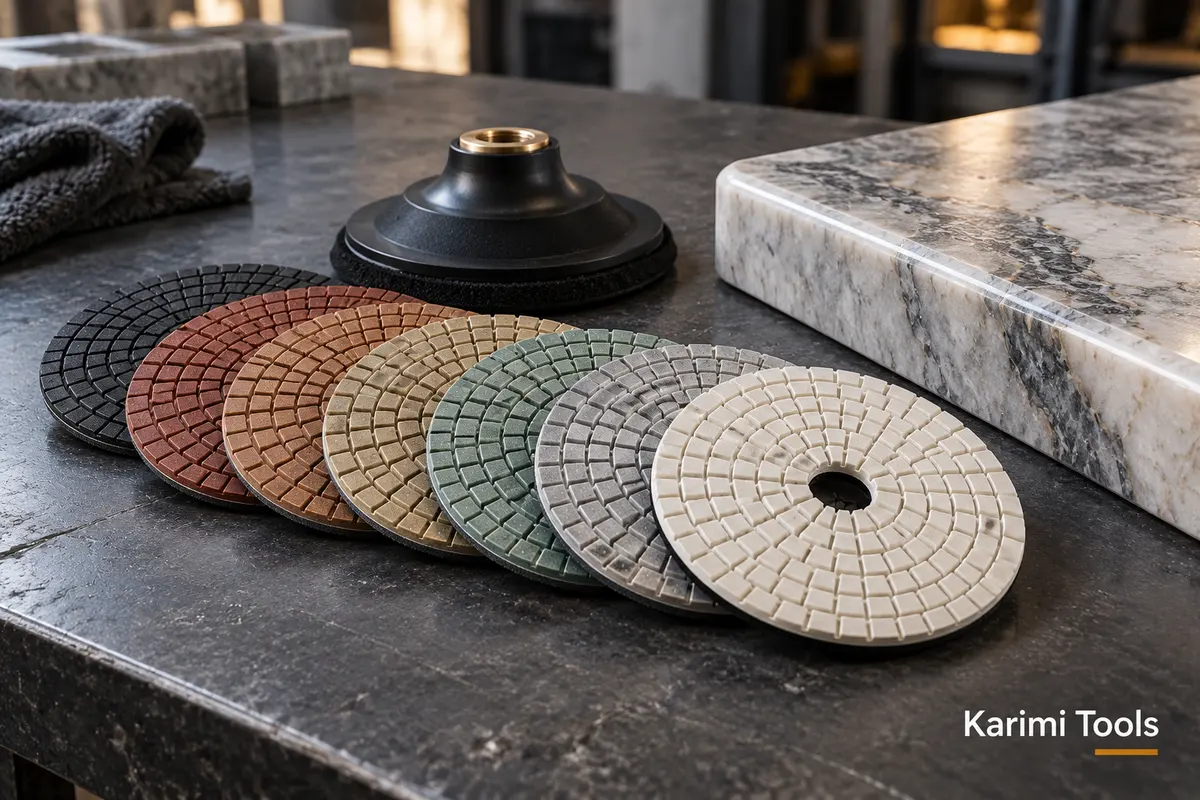
Diamond polishing pads: choosing the right set
Diamond polishing pads should match the stone, the current surface condition and the machine. Before buying a set, decide whether you need to remove earlier marks, refine a prepared edge or develop the final gloss. A newly cut edge and an already finished surface are different starting points. Agree on the desired finish, including a deliberate matte result if that is the project brief. The starting and finishing stages should follow that aim, not merely the largest grit number in a catalogue.
Match the pad system to the stone
Check the stated suitability for granite, marble, calcareous stone or engineered material rather than assuming that every polishing product is interchangeable. A concrete-floor tool is not automatically a marble-edge solution. Husqvarna identifies wet use and supported materials for specific polishing tools. Treat the exact product specification as the reference, and arrange a sample evaluation when the final appearance is sensitive.
Plan the sequence, not just the last grit
A grit number describes a stage within a tool system, but sets do not all use the same sequence. The same number on two different product families is not a guarantee of identical behaviour. Follow the sequence specified for the set and inspect remaining marks before moving on. Do not use pad colour as a universal grit code: colours can differ between manufacturers and families.
Keep each stage free of carry-over debris
Use a simple inspection routine: clean the surface after each stage and examine it under suitable light. Label and separate the tools so that the wrong stage is not introduced accidentally. If the finish differs from the agreed sample, identify where the difference began. Repeating the final stage without understanding the earlier condition is not a useful way to diagnose the problem.
Confirm wet or dry use and the backing pad
Check the wet or dry rating of both the pad and the machine. Wet operation requires equipment designed for water delivery. Match pad diameter, backing pad, connection and operating limit, and inspect the attachment surface. Do not use damaged pads or a weak attachment, or operate outside approved limits. The manufacturer’s product instructions take priority over generic polishing advice.
What to include in a set enquiry
Provide stone type, current condition, desired finish, polisher model, backing diameter and approved working method. Clear close-up photographs can help describe an existing surface. Ask for a compatible family and an appropriate backing pad, rather than mixing products only because their colours look similar. Compare the cost and coverage of the complete sequence: an incomplete set may not cover your starting point and final target.
Frequently asked questions
Is a higher grit always better?
No. The final stage must match the material and desired appearance, with the earlier stages completed appropriately.
Can a dry pad be used with water?
Only when the specific pad and equipment permit that use. Do not infer wet-system compatibility from an accessory label.
Which category should I compare first?
Compare diamond polishing pads and handheld polishers alongside the stone and machine specifications.
Related categories and further reading
Manufacturer technical references
For operating details, check the current technical sheet and instructions for the exact model. The cover is an editorial illustration and does not identify a specific commercial product.