

“Stone adhesive” describes a category, not a single formulation. Match the application, exposure, colour and the exact product’s technical information.
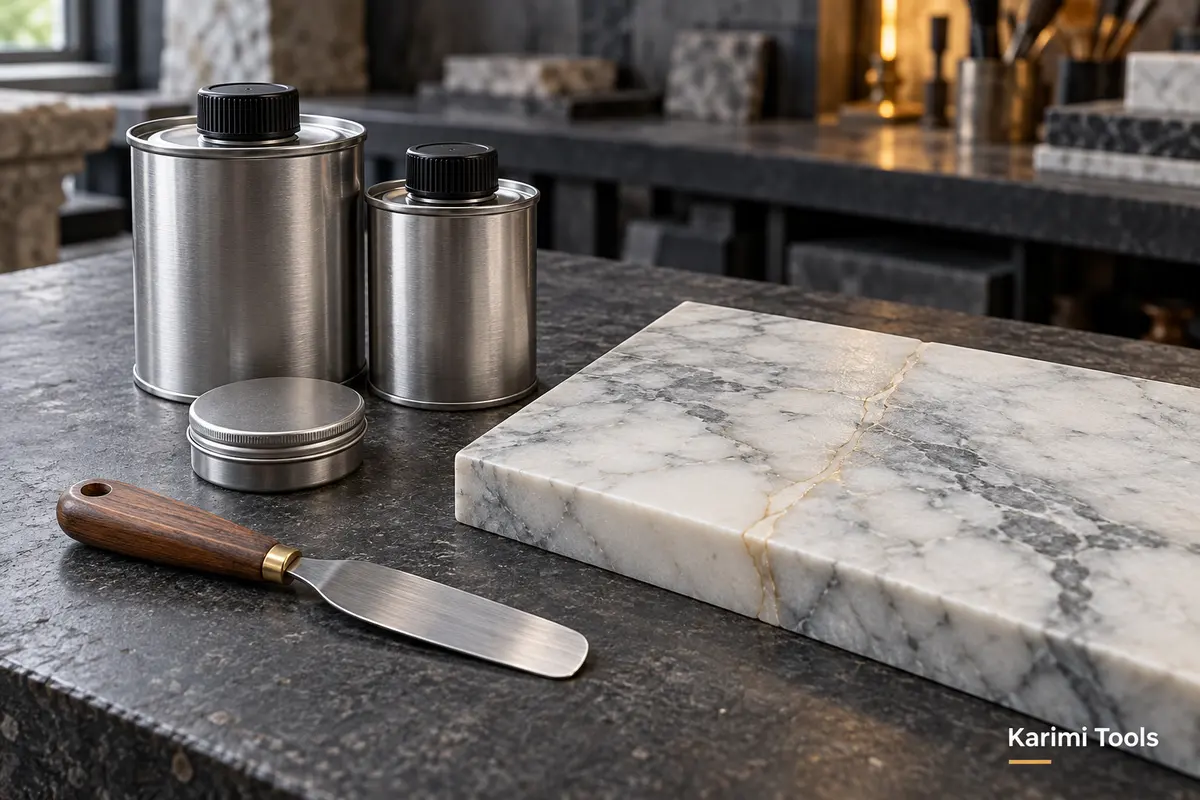
Stone adhesive: epoxy or polyester for your job?
Choose stone adhesive by the job first: a cosmetic repair, pore filling, bonding two pieces or reinforcing a slab. These are not automatically the same application. Identify the material, exposure and working conditions next. Epoxy and polyester name chemical families; the useful comparison is between exact products and their approved uses, appearance and technical data. For sensitive or load-bearing connections, the product and joint design require approval from the project’s responsible specialist.
Separate repair from bonding requirements
Filling a small chip and joining pieces that carry loads are different design problems. Ask the supplier to identify the approved purpose instead of relying on the phrase “strong glue.” The technical sheet should name compatible materials, application and limits. A façade, lifting or structural connection needs a project-specific decision from the responsible professional; a general buying article cannot establish its adequacy.
Compare epoxy and polyester product by product
Tenax lists polyester mastics and epoxy mastics as separate products. Tixo XE and Fixtop, for example, have different stated mixing requirements and timing information. The purchasing lesson is that instructions from one formulation must not be carried over to another. Compare approved use, liquid or paste form, tinting options, exposure limits and working-time information for the exact products being considered.
Do not guess ratios or cure times
Read the resin-to-hardener requirement, whether it is by weight or volume, and temperature conditions from the exact sheet and label. Extra hardener is not a universal shortcut to faster work. Gel time, touch-dry timing and readiness for a later operation are different concepts. Measure and mix by the specified method, and plan the next operation around the relevant stated condition rather than an assumed single cure time.
Test colour and appearance on a sample
Stone colour and final finish affect the visibility of a repair. Evaluate a small sample made with the actual stone and product under the intended lighting. For indoor or outdoor use, moisture and colour stability, consult the product’s exposure information instead of making a family-wide assumption. The word “transparent” alone does not guarantee an invisible joint in every stone or finish.
A purchase and preparation checklist
Provide stone type, application, indoor or outdoor location, moisture conditions, colour target and schedule. Check storage requirements, product date information, supplied components and safety documentation. Prepare the surface and workspace according to the manufacturer, including the specified protection and ventilation. Before the main application, confirm sample compatibility and the relevant timing for subsequent finishing or installation.
Frequently asked questions
Is epoxy always the better choice?
No. The appropriate product is the one approved for the actual application and conditions, not simply the chemical family name.
Can hardeners be swapped between products?
Do not do so without explicit manufacturer approval. Components and ratios belong to the specified product system.
What matters most in an enquiry?
Along with the material, state whether the job is repair, bonding or reinforcement and describe the service environment.
Related categories and further reading
Manufacturer technical references
For operating details, check the current technical sheet and instructions for the exact model. The cover is an editorial illustration and does not identify a specific commercial product.